
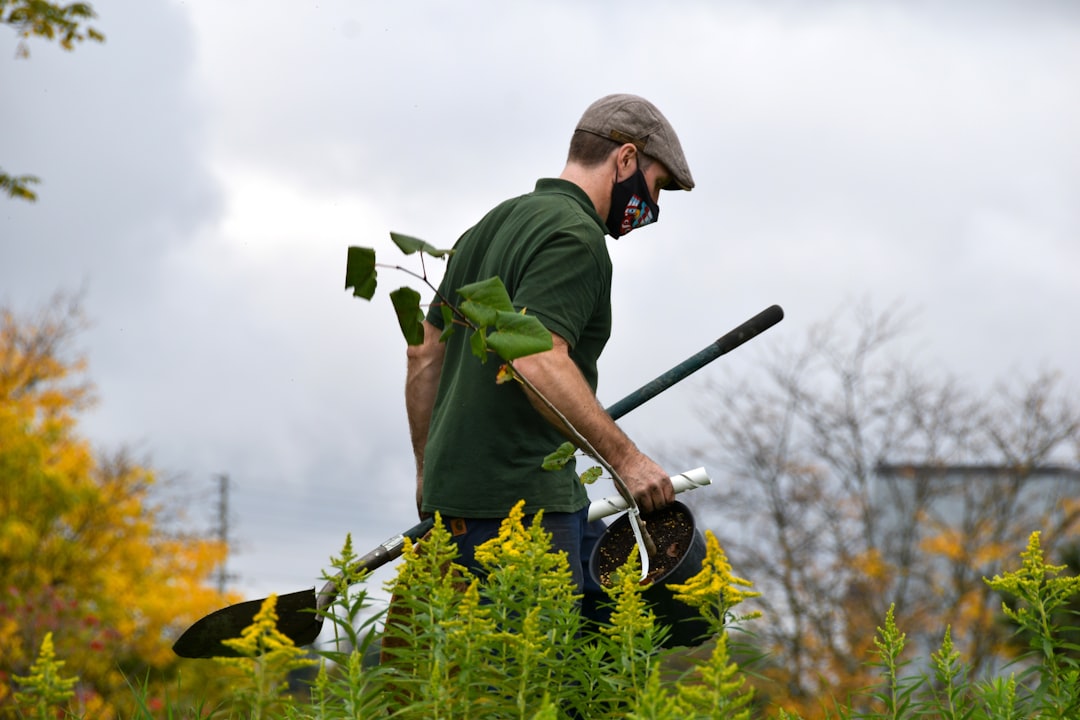
What if one afternoon’s work could cut your watering in half, smother most of your weeds, and slowly feed your soil for free? That’s mulch—the closest thing gardening has to a cheat code. But two details decide whether it helps or quietly harms: which type you use, and how you apply it. The infamous “mulch volcano” piled against a tree trunk does more damage than no mulch at all. Here’s how to get both right.
What mulch actually does for you
- Cuts watering by slowing evaporation—often dramatically in summer.
- Suppresses weeds by blocking the light their seeds need to sprout.
- Regulates soil temperature, keeping roots cooler in heat and insulated in cold.
- Feeds the soil—organic mulches break down into the exact organic matter that improves soil structure.
Pick the right type for the job
Not all mulch is equal—each has a best use and an honest downside:
| Mulch | Best for | Lasts | Watch out for |
|---|---|---|---|
| Shredded bark / wood chips | Beds, around shrubs & trees | 1–2 years | Keep off stems; ties up nitrogen if dug in |
| Straw | Vegetable beds | 1 season | Use straw, not hay (hay carries seeds) |
| Shredded leaves | Everywhere—and free | ~1 season | Shred them, or matted whole leaves block water |
| Grass clippings | Veg gardens (thin layers) | Weeks | Apply thin & dry, or it mats and smells |
| Gravel / stone | Paths, succulents, decorative | Indefinite | Adds no nutrients; hard to remove later |
For most gardens, shredded leaves are the smart-money choice—they’re free every autumn and break down into first-rate soil food. Bag your leaves, run a mower over them, and you have a season’s mulch at no cost.
The two rules that make or break it
Rule 1 — Depth: aim for 5–7 cm. Thinner and weeds push through; much thicker and you can suffocate roots and keep the soil waterlogged. Five to seven centimeters is the sweet spot for beds.
Rule 2 — Never pile it against stems or trunks. This is the big one. Mulch heaped against a plant’s base traps moisture against the bark, invites rot, and encourages pests and disease. Always leave a gap of a few centimeters around every stem and trunk—think “doughnut, not volcano.” This single mistake kills more trees than drought.
When and how to apply
The best time is mid-to-late spring, once the soil has warmed but before summer heat and weeds arrive—mulching cold soil just keeps it cold. A second lighter top-up in autumn insulates perennial roots for winter. Before mulching, weed the area and water the soil; mulch locks in whatever condition it covers, so you want it weed-free and moist underneath, not bone-dry. For deeper regional guidance, extension programs like the University of Illinois Extension are a solid free reference.
How much to buy (a 30-second calculation)
Guessing means either running short or overpaying, so do the quick math. Multiply your bed’s length × width to get the area, then multiply by your depth (use 0.06 m for a 6 cm layer). That gives the cubic meters of mulch you need. For example, a 3 m × 1 m bed at 6 cm deep needs 3 × 1 × 0.06 = 0.18 m³. Bagged mulch lists its volume, so divide to get the number of bags—and buy about 10% extra for settling. This one calculation saves the classic mistake of a half-mulched bed and a second trip to the store.
Living mulch: the plant-based option
Instead of (or alongside) a material mulch, you can cover soil with low-growing plants—a “living mulch” or cover crop. Clover between vegetable rows, creeping thyme in ornamental beds, or a winter cover crop of rye all shade the soil, suppress weeds, and hold moisture like mulch does, while also adding organic matter and, in the case of clover, feeding the soil with nitrogen. It’s the most sustainable form of mulching because it renews itself, though it takes a little more planning than spreading bark.
Common mulch mistakes
- The volcano. Worth repeating—mulch against the trunk is the number-one killer.
- Too thick. A 15 cm blanket looks tidy but drowns roots and can go anaerobic and sour.
- Fresh wood chips dug into soil. On the surface they’re great; mixed in, they temporarily rob nitrogen as they decompose. Keep them on top.
- Hay instead of straw. Hay is loaded with seeds—you’ll mulch in a weed problem.
Do I need to remove old mulch before adding new?
For organic mulches, no—the old layer is breaking down into soil, which is the point. Just top it up to maintain the 5–7 cm depth. Only remove mulch if it has matted into a water-repelling crust, in which case fluff or replace it.
